By Kelly McAtee | TheTripThread | Last Updated May 2026
Grenada
An island where the air carries nutmeg, the hills hold waterfalls, and the welcome runs on island time.
Adventure & Nature | Sail & Sea Life | Culinary Caribbean | Sustainable Shores | Romance & Connection
Best for travelers drawn to rainforest hikes, sculpture-park dives, working spice and cocoa estates, and slow-paced local warmth — over polished resort uniformity or club-driven nightlife scenes.
Not for travelers who expect uniformly polished infrastructure, a constant club-night scene, or property-bound days where the island stays outside the gate.
☀️ Best months: Jan–May (May is the sweet spot) 💲 Average cost: $$$ 🕶️ Vibe: Laid-back with festival bursts
Reality Check (Read This Before You Book)
Most travelers stay on the south coast and hire a driver for trips inland. A typical day means beach time at Grand Anse or Morne Rouge, a half-day driver trip to the rainforest interior or the working spice and cocoa estates, and a walk through St. George's on a day when cruise ships aren't in port. The island fills up December through April for dry season, and Spice Mas in early August is a separate cultural peak.
The biggest misconception: "Spice Isle" no longer means cheap or undiscovered. Grenada is mid-upper-Caribbean pricing, a busy cruise port, and a working island — its payoff is cultural depth and eco-adventure, not seclusion or polish.
If you expect every restaurant reliably open and every rental in showroom condition, the looser rhythm will frustrate — service here runs on island time, not a tight clock.
If you want late-night clubs as the daily default, you'll feel the absence; Grenada's social spine is Fish Friday, beach bars, and rum-shop conversation, not a club circuit.
If you're unwilling to drive winding roads or pre-book a trusted driver, the island closes in fast around your hotel, and a property-bound Grenada is a much smaller version of the trip. A Caribbean destination where the experience is delivered to you, not built around exploring, is a better match.
Why You’ll Love It
In Grenada, the warmth is unforced. The air carries nutmeg and cocoa, rivers run through the rainforest interior, and working spice and cocoa estates open their doors to travelers who make the drive. There's a resort corridor on Grand Anse and a small nightlife pocket near St. George's, but the rest of the island carries on as a working country — and that's the point.
Days here have a clear shape. Mornings are slow — coffee with a view of Grand Anse, breakfast that arrives when it arrives. By midday a driver-guide appears, and the trip extends inland: Annandale Falls, Belmont Estate, lunch in Gouyave, a waterfall hike, the rum-and-spice loop. Afternoons end at the beach with rum punch and steel pan. The Carenage glows at sunset; Fish Friday in Gouyave runs late on a weekend; on most other nights the island goes quiet by ten.
What sets Grenada apart is that it never stopped being a working island. Spice and cocoa are still cultivated and processed here at scale; Spice Mas in August is a real cultural ritual, not a tourism showcase; rum is distilled in places that have been running on water-wheel power for two centuries. Compared to islands designed around the resort experience — where the destination is delivered to you — Grenada asks travelers to participate. The reward is texture: a country whose identity exists outside the visitor economy and lets visitors join in.
Best for travelers who choose cultural depth, eco-adventure, and a warm working-island rhythm over delivered-resort polish or nightlife circuits.
Grenada is often recommended for couples and eco-travelers seeking rainforest hikes, working spice and cocoa estates, sculpture-park diving, and a slower Caribbean pace with real cultural depth.
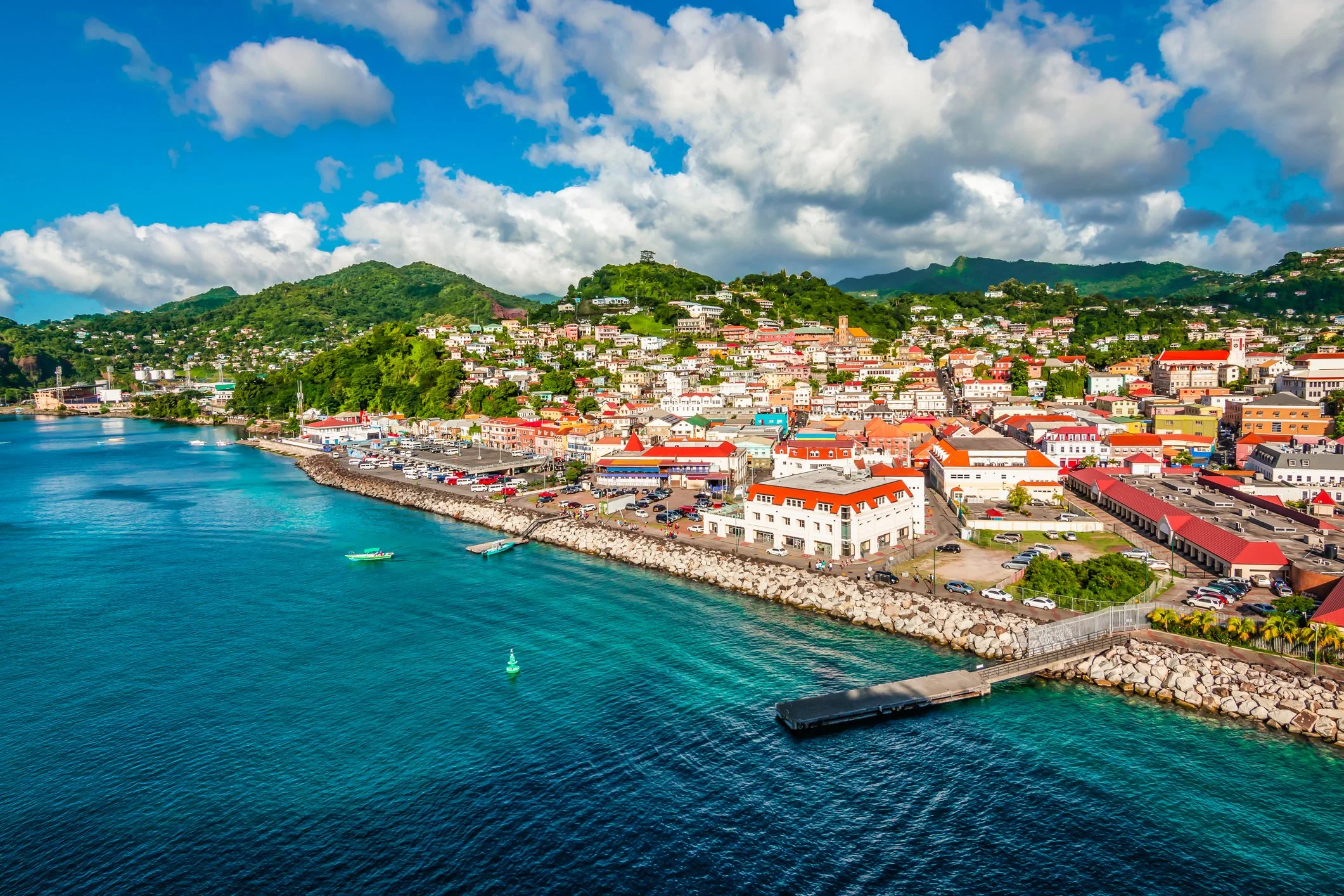
This is Grenada
Green volcanic hills behind a pastel horseshoe harbor, with rainforest, rivers, and working spice estates within an hour of every beach.
Part of the Greater Caribbean Collection on TheTripThread — a destination reference system built for travelers deciding where they'll feel right, not just where to go. Grenada is for travelers who value cultural depth, eco-adventure, and warmth that doesn't perform.
Common Experience Patterns

Unlike Grand Cayman or Aruba — where the tourism clock runs tight and service is on demand — Grenada operates as a small country with a tourism layer on top. Cross-island drives take twice what Maps suggests, and most of the island outside the resort corridor closes on Sundays.
Grand Anse is the long, calm white-sand crescent — wider and more populated than Anguilla's beaches, less manicured than Aruba's. Morne Rouge ("BBC Beach") is quieter and reef-protected. Evenings cluster on the south and at Gouyave's Fish Friday, a weekly street-food market with no real equivalent on polished Caribbean islands.
Travelers who've done Grand Cayman, Aruba, or Turks & Caicos feel the difference immediately — those islands deliver the experience to you. Grenada doesn't try to. The island assumes you'll hire a driver, hike a waterfall, and accept that some places close for an hour at three. Repeat visitors come for that texture.
Where we eat
Dining concentrates in three pockets: the Grand Anse / Lance aux Epines corridor for hotel and boutique restaurants, the Carenage for harbor-side casual, and Gouyave for Fish Friday. A mid-tier dinner runs US$25–45 per person. Belmont Estate's prix fixe lunch is the working-estate experience worth driving for.
Travelers praise the sincerity of the welcome, the dive scene at the Underwater Sculpture Park and the Bianca C wreck, and the working spice-and-cocoa heritage that St. Lucia and Barbados don't quite have. They get caught off guard by full Carenage cruise days and how thin Spice Mas lodging runs if they don't book early. Locals and repeat visitors alike describe Grenada as a working country with cultural depth — especially for travelers who want eco-adventure and a slower rhythm, while those who prefer resort polish are a little disappointed.
Where we go
The default rhythm is to base yourself in the south and use a driver for day-trips: Annandale Falls, Grand Etang, Belmont Estate, and the rum-and-spice loop in St. Patrick parish. Buses are cheap and useful for short hops along the south coast (about US$1–2 per ride), but anything beyond that calls for a trusted driver hired in advance — most repeat visitors use the same driver across the trip.
What we love
Grenada's pull is in its scale: small enough that the same shopkeeper remembers a returning visitor, large enough to disappear into a rainforest river for an afternoon. Working spice and cocoa estates are the through-line — a country still doing what its name advertises. The welcome is the point, and it doesn't perform.
About this section:
This section is built from publicly shared traveler perspectives and credible regional reporting. We treat it as sentiment and cross-check factual claims where possible. We intentionally limit dependence on review marketplaces where paid, promotional, or otherwise unrepresentative input can blur the picture.
Identity
Vibe Descriptors
Laid-back · Authentic · Welcoming · Lush · Festive
……….
Core Audience
Couples and eco-travelers who want rainforest hikes, working spice and cocoa estates, and warm local culture without resort polish
……….
Best For (Trip Types)
Romantic & Couples · Nature & Wildlife · Diving & Snorkeling · Culture & History
……….
Known For
The Spice Isle — working nutmeg and cocoa estates, century-old water-wheel rum, the Underwater Sculpture Park, and the long calm crescent of Grand Anse Beach
……….
Trip Thread Theme(s)
Friction & Tradeoffs (Read This Before You Book)
Cost Pressure. Grenada is mid-upper Caribbean pricing now. The sharpest price friction shows up in dining (mid-tier dinner US$25–45 per person, with operating hours and quality inconsistent outside Grand Anse and Lance aux Epines) and in taxis at the cruise port and Sandals pickup, where overcharging is documented enough that locals direct visitors to drivers registered with the Grenada Taxi Association.
Mobility / Getting Around. Most travelers hire a trusted driver for the trip rather than rent a car — roads are narrow and winding, parking is improvised, and rentals run utilitarian. Buses (about US$1–2 per ride) work for short south-coast hops between Grand Anse, Lance aux Epines, and St. George's, but anything further calls for a pre-booked driver. Cross-island drive times run roughly twice what Maps suggests.
Autonomy vs Structure. Grenada lands somewhere between spontaneous and planned. The south-coast base zone (Grand Anse, Lance aux Epines, Morne Rouge) is walkable for meals and beach days, but everything inland — Grand Etang, the waterfalls, the working estates, a Carriacou trip — needs a driver booked a day or two ahead. If you like waking up and deciding the day, this will feel limiting. If you're happy to plan one or two driver days inside a beach-focused week, it works.
Crowd Texture. Cruise traffic shapes the social feel of the island more than anything else. About 370K passengers came through in 2025 (up 17.5% year over year), and a few midweek winter days see three ships in port. On those days the Carenage and Annandale Falls book up by 9 AM. Outside cruise days, the island reads as a working country with a south-coast resort corridor — unlike Aruba's continuous resort strip or Puerto Rico's urban street life.
Culture Access. Grenada makes its local culture easier to access than most Greater Caribbean destinations. English is the working language, working estates (Belmont, River Antoine, Westerhall) are open daily for tours, and Fish Friday in Gouyave is a local ritual that visitors join rather than a tourism showcase put on for them. Unlike Antigua or the Dominican Republic, where resort guests can spend a week without leaving the property, Grenada properties expect guests to spend at least some days off-site.
Variety Ceiling. For a week, the activity menu feels rich: waterfalls, dive sites, estates, beach corridors, plus a Carriacou extension. At ten days or longer the same restaurants and beaches start to repeat. The recommended window is 5–7 nights with Carriacou as the extension that refreshes the trip — rather than a 10+ day single-island stay.
Sand & Sea Character
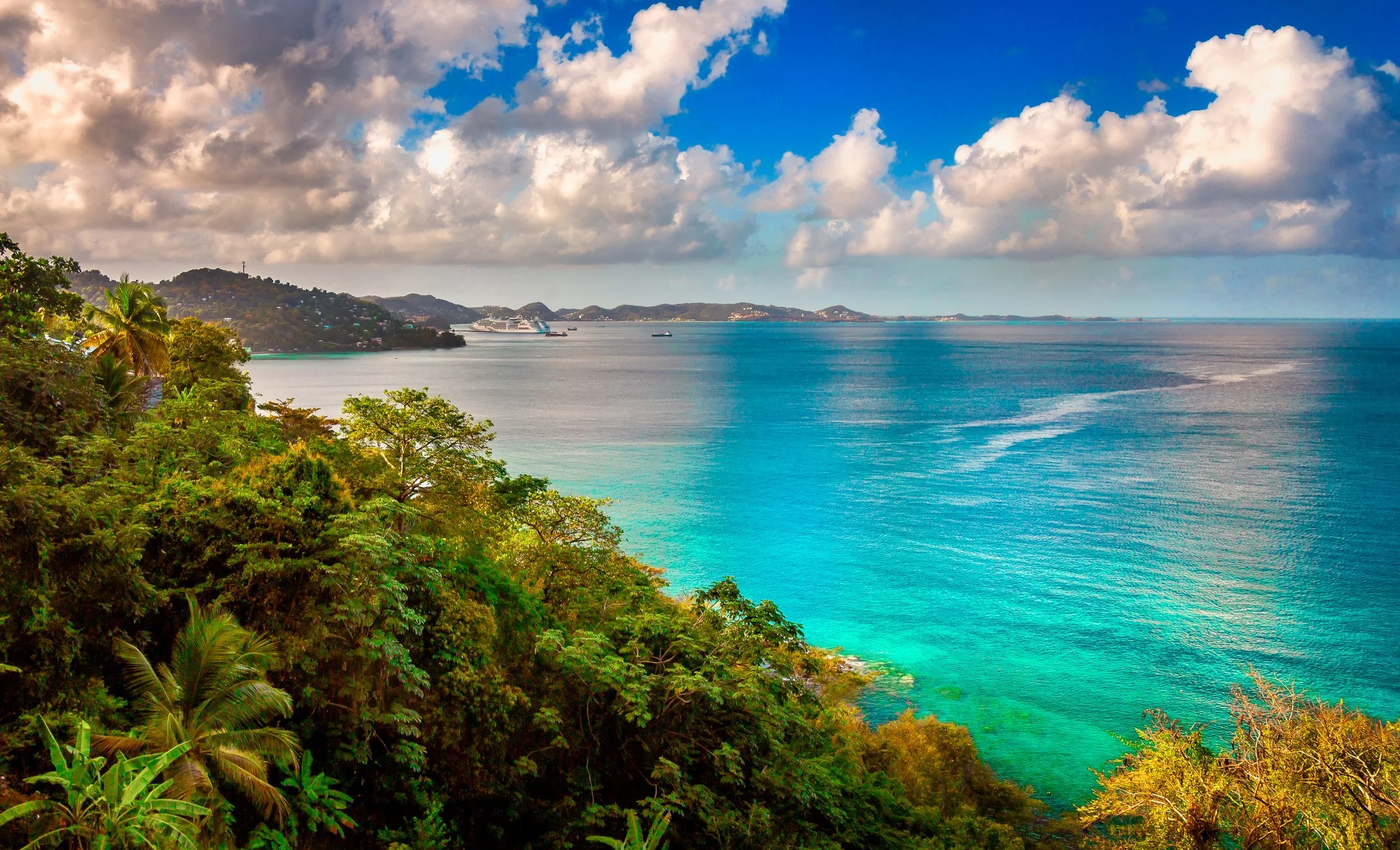
Grenada's south coast has white, fine sand, along with most of the island's beach hotels. Grand Anse is the longest stretch — soft white sand, gentle slope, easy underfoot — with Morne Rouge ("BBC Beach"), Pink Gin, and Magazine Beach extending that pattern westward. The east and north coasts shift to golden: Bathway is a 1-mile reef-protected stretch, and Levera is wilder and dark gold. The west coast has a small pocket of volcanic black sand at Black Bay. It's a real swim beach, but the darker sand makes the water look deeper-toned in photos even though it's still clear.
Water clarity is best on the calmer south and west Caribbean coasts; the east coast Atlantic side gets cloudier in surf and after heavy rain. Color shifts by where you stand: bright turquoise where white sand sits shallow, deeper teal where the slope drops or seagrass takes over. Waves are calm at Grand Anse, Morne Rouge, Pink Gin, and the south coast generally; Bathway is swimmable behind its reef ledge but rougher outside it; Levera is for walking and turtle-watching, not swimming. If you want bright turquoise and easy swimming, base on the south coast. If you're after snorkeling and reef diving — and don't mind water that reads darker — head to the west coast around the Molinere–Beauséjour Marine Protected Area. If you're chasing dramatic open-coast scenery, the north and east coasts (Bathway, Levera, Petite Anse) deliver, with the caveat that you'll be walking, not swimming.
Explore Grenada— Map & Highlights
Grenada sits at the southern edge of the Eastern Caribbean, the spice-and-cocoa island closest to the South American shelf. Most travelers stay on the south coast and explore inland by driver — Grand Anse and Lance aux Epines for the beach base, Grand Etang and the working estates for the days in between. The rhythm is two-speed: beach mornings and an inland excursion most days, then quiet evenings. Unlike resort-style Caribbean islands where the whole trip happens inside the property, Grenada asks travelers to leave the gate. The map below is curated, not comprehensive — it's not a checklist to conquer, and it does not try to mark every beach, restaurant, or landmark on the island.
Beaches
As we covered in Sand & Sea Character, Grenada's coastline reads in three flavors: the calm white-sand south coast where most of the beach hotels sit, the dramatic golden Atlantic-facing east and north, and a small volcanic black-sand pocket on the west. The pins below mark the beaches worth knowing within each zone. For a classic beach vacation, base south; for off-the-beaten-path days, head north.
Food & Drink
You've already heard the gist of Grenada's dining map in Common Experience Patterns — the Grand Anse and Lance aux Epines corridor, the Carenage in St. George's, and Gouyave's Fish Friday. The pins below mark those zones geographically. The practical add: food-driven travelers do best basing in Lance aux Epines, which packs the highest density of mid-to-upscale boutique restaurants within walking distance of each other.
Activities
Assuming you've hired a driver (as most travelers do), the activity menu splits cleanly into three zones: the central rainforest for Grand Etang and the waterfalls, the north and east for the working estates (Belmont, River Antoine, Westerhall), and the west coast for the Underwater Sculpture Park and the Bianca C dive wreck. Active eco-travelers do best basing on the south coast for the shortest driver runs to all three.
Where to Stay in Grenada
Grenada is varied enough that where you stay shapes the whole trip. The south coast has the resort corridor and the foodie peninsula; the southeast has the retreat zone; the north coast is the country option. Below, The Trip Thread lists and describes the various areas to stay in Grenada — each offering a different balance of privacy, scenery, and local character.
Grand Anse — The Main Hotel Corridor
Grand Anse is the 2-mile south-coast beach corridor and the default base for most first-time Grenada visitors. The mix of properties is the widest on the island, from full all-inclusive resorts to mid-tier boutique hotels to longer-stay self-catering apartments — most within a short walk of each other and the beach. It suits travelers who want one base for the trip and quick access to dining, the Carenage, and inland day trips. The trade-off is the busiest beach end on cruise days and a less quiet, less local feel than the alternatives.
Why stay: Easiest access to everything south-coast — most property variety, broadest dining mix, shortest driver runs to inland day trips.
Why not: Busy beach end on cruise days; less quiet and less locally rooted than Lance aux Epines, Morne Rouge, or La Sagesse.
Lance aux Epines — Boutique Peninsula, Foodie Pocket
Lance aux Epines (sometimes written L'Anse aux Epines) is the residential peninsula immediately east of Grand Anse, with a long quiet beach and a handful of small boutique stays. It is where Grenada's mid-to-upscale restaurant cluster sits — the highest density on the island, most of it walkable. It suits travelers who plan most evenings within a short stroll and who value a quieter base than the resort corridor a few minutes west. The trade-off is a smaller beach scene and a longer drive to reach the north coast or the cross-island rainforest.
Why stay: Quieter than Grand Anse and foodier than anywhere else on the island — most dinners walkable.
Why not: Smaller beach scene than Grand Anse and longer drives to anything off the south coast.
Morne Rouge — Quieter Beach-Adjacent Pocket
Morne Rouge (locally "BBC Beach") sits between Grand Anse and Lance aux Epines on a smaller, reef-protected horseshoe bay. The cluster of boutique hotels here is smaller than Grand Anse's resort line, but the beach itself is the calmest and most family-friendly in the area. It suits travelers who want a quieter beach day and a short walk over to Grand Anse for dining, without staying inside the cruise-day busier zone. The trade-off is fewer on-site dining options and less to do outside the immediate beach.
Why stay: Calmest beach on the south coast with easy walking access to Grand Anse dining and amenities.
Why not: Thinner on-site dining than Grand Anse or Lance aux Epines; less to do outside the beach itself.
La Sagesse / St. David's — Southeast Retreat Zone
La Sagesse sits in St. David's parish on Grenada's secluded southeast coast — the retreat-style zone with the island's most secluded high-end stay options. The setting wraps a calm Caribbean bay, mangrove forest, and the La Sagesse Nature Centre, with very little around it for miles. It suits travelers who want a slow, designed-for-quiet trip with wellness as the spine — and who are happy to drive 30 to 45 minutes for dining variety. The trade-off is the longest drive of any south-side base to Grand Anse, the Carenage, and the cross-island inland zone.
Why stay: Genuine seclusion and the island's highest-end wellness anchor, in a working mangrove and Caribbean-bay setting.
Why not: Long drives to dining variety, day trips, and the airport — the trip has to be built around the property.
North Coast (Sauteurs area) — Country Base for Upcountry Exploration
The north coast around Sauteurs is the country-base option — a small handful of boutique inns near Petite Anse and Bathway, with the slowest pace on the main island and the easiest access to the north-coast estates (Belmont, River Antoine) and Levera National Park. It suits travelers who want the working-country side of Grenada more than the resort corridor — especially repeat visitors who've already done the south coast. The trade-off is a long drive to anything south, including the airport, dining variety, and the cross-island rainforest.
Why stay: Slowest pace on the main island and the closest base to the north-coast estates and Levera National Park.
Why not: Long drives to anything south of the rainforest spine — including the airport, the resort dining cluster, and the cross-island loop.
Practical Snapshot
-
January through May is Grenada's dry season and the broad sweet spot. Mid-April through May is the quietest window — dry-season weather still holds, but the cruise calendar thins out. Grenada sits at the southern edge of the hurricane belt, so direct hits are rare. Spice Mas in early August is the cultural peak, but it coincides with wet and storm season.
-
The Eastern Caribbean Dollar (XCD, often written EC$) is the official currency, pegged at 2.7 to the US dollar. USD is widely accepted at hotels and mid-tier restaurants, but you'll usually get change back in EC. Cards work fine at the resort and dining corridors; carry cash for taxis, beach vendors, the distilleries, buses, and rum shops — most of those operations are cash-first.
-
English is the official and working language, and you'll never need anything else to get around. A Grenadian Creole — French-influenced and locally called Patois — surfaces in everyday speech and place names, especially among older speakers and on Carriacou, but it doesn't shape day-to-day interactions for visitors.
-
Most visitors fly into Maurice Bishop International (GND) on the south coast — about a 15-minute drive to the Grand Anse hotel corridor. JetBlue runs nonstop from New York; American flies in from Miami year-round and Charlotte seasonally; Delta added daily nonstop from Atlanta in December 2025. Air Canada and WestJet handle Toronto; British Airways flies seasonal nonstop from London Gatwick, with Virgin Atlantic via Bridgetown the steady year-round option.
-
Grenada lands at mid-to-upper Caribbean pricing — not the bargain it once was, not the highest end either. A quick calibration: local lunches = 💲, inland guesthouses and self-catering apartments = 💲💲, Grand Anse beachfront resorts and retreat-style luxury stays = 💲💲💲💲. Mid-range dining is the norm, with island-time service and rental cars on the utilitarian side.
-
Nightlife on Grenada is low-key and pocketed, not a circuit. The social spine is Fish Friday in Gouyave, beach bars and steel-pan nights along the south coast, and a small student-and-expat scene around True Blue. Clubs are limited to a few venues open Wednesday through Saturday. If you want late-night clubs as the daily default, this is not your island.
-
Skip the rental car and book a trusted driver — roads are narrow and winding, and rentals tend to be utilitarian. Buses cost about US$1–2 per ride and handle short south-coast hops between Grand Anse, Lance aux Epines, and St. George's. For anything inland or up the north coast, book your driver a day ahead and use the same one across the trip.
-
The US State Department raised Grenada to Level 2 ("Exercise Increased Caution") in January 2026, citing risk of armed robbery, assault, and burglary. Day-to-day in the south-coast tourist corridor (Grand Anse, Lance aux Epines, Morne Rouge) still feels comfortable. Avoid walking alone at night on isolated beaches or in poorly-lit areas; use Grenada Taxi Association drivers; do not resist a robbery if one occurs.
Same-sex sexual conduct is criminalized in Grenada — Section 431 of the Criminal Code carries up to ten years' imprisonment, and a constitutional challenge under ECADE is pending (decriminalization is possible in 2026 but has not yet been ruled). Resort tourist zones operate with discretion-based tolerance for same-sex couples; local-facing and rural settings are not welcoming, and public displays of affection are not advisable for anyone. LGBTQ+ travelers seeking more legally welcoming Caribbean options will find Antigua, Barbados, and St. Lucia significantly more open.
-
Tap water is safe to drink on the main island. Electricity is 220V on UK-style three-pin plugs — bring an adapter and a converter if you're coming from the US. Camouflage clothing is illegal for civilians and the law is actively enforced; leave the patterned hat and cargo shorts at home. Sundays are very quiet outside the resort corridor — many restaurants and businesses close.
-
Grenada's eco identity is genuine, not branding. The Molinere–Beauséjour Marine Protected Area funds reef and ranger work through a small user fee (US$3.50 per snorkel/dive trip, rising to US$7 in October 2026). The country also runs a Sargassum Operational Response Plan with biogas valorization in pilot. Reef-safe sunscreen is the practical visitor ask — bring some from home, since it's harder to find on the island.
Compare Similar Caribbean Destinations
Thinking about Grenada, St. Lucia, or Barbados? Here’s how these greater Caribbean destinations differ in rhythm and culture.
GRENADA
Vibe & Energy. Laid-back working-country pace with cultural bursts around Spice Mas — the trip rewards exploring more than staying put.
Dining & Culture. Working spice and cocoa estates (Belmont, River Antoine) give the island a real agricultural through-line; Fish Friday in Gouyave is the weekly cultural pulse.
Cost & Crowds. Mid-to-upper Caribbean pricing; medium tourism saturation, heavier cruise pulses at the Carenage on multi-ship winter days.
Accessibility. Direct flights from major US, Canadian, and UK gateways into Maurice Bishop International (GND); no second-airport hops, 15-minute transfer to the resort corridor.
Nightlife / Social Scene. Low-key and pocketed — beach bars, Fish Friday, and a small student-and-expat scene; not a club circuit.
Best For. Couples and eco-travelers who want cultural depth, working agricultural heritage, and a slower rhythm than the more developed Caribbean islands.
ST LUCIA
Vibe & Energy. Romantic and dramatic — peaks, rainforest, and honeymoon-grade resorts shape a slower, polish-forward rhythm.
Dining & Culture. Creole cuisine, the Pitons as the trip's defining image, and a year-round festival calendar (Jazz Fest, Carnival, Roots & Soul) carry the cultural side.
Cost & Crowds. Mid-to-upper Caribbean pricing with a stronger luxury tier; busier hotels at Soufrière and Rodney Bay on peak weeks.
Accessibility. Two airports — UVF in the south for resort access, SLU in the north for Rodney Bay — adds friction; transfers from UVF run an hour-plus.
Nightlife / Social Scene. Mostly resort-anchored and dinner-driven; Rodney Bay carries the late-night energy.
Best For. Couples chasing dramatic landscape, peak romance, and a polished resort experience.
BARBADOS
Vibe & Energy. More cosmopolitan and culturally layered — a working country with a polished dining scene and a real urban pulse around Bridgetown.
Dining & Culture. One of the Caribbean's strongest fine-dining scenes; Oistins Fish Fry is the weekly cultural standout; the rum heritage runs older than Grenada's.
Cost & Crowds. Higher pricing than Grenada at the upper tiers; busier tourism corridor on the west coast, quieter on the east.
Accessibility. Direct flights from US, UK, and Canadian gateways into Bridgetown (BGI) — among the easiest Caribbean access for many travelers; quick transfers to the west-coast corridor.
Nightlife / Social Scene. Varied — beach bars, fine-dining restaurants, and a real late-night scene at St. Lawrence Gap.
Best For. Travelers who want a polished mix of dining, culture, and beach without sacrificing infrastructure.
Pick Grenada if you want eco-adventure, working spice and cocoa heritage, and a working-country pace over polished tourism.
Pick St. Lucia if you want dramatic peaks, honeymoon-grade resort polish, and the Pitons as the trip's defining image.
Pick Barbados if you want one of the Caribbean's strongest dining scenes, urban culture, and easier access from major gateways.
Tie-breaker: how polished do you want it — Grenada is loosest, St. Lucia is romance-polished, Barbados is the most cosmopolitan.
Local Truths
Camouflage clothing is illegal for civilians in Grenada — locals will tell you the fines and confiscations are real, not a tourist myth.
~~~~~
Around the cruise port, locals and repeat visitors keep telling people the same thing: sort taxis and tours carefully, because that is where overcharging and scammy behavior show up most.
~~~~~
Hurricane Beryl in July 2024 hit Carriacou as a Cat 4 and Petite Martinique catastrophically; the main island only took Cat 1 winds in the southwest with one fatality — locals push back hard when travel media talks about Grenada itself as if it had been devastated.
~~~~~
Visitors are often told to use taxis rather than romanticizing a rental-car road trip — the roads are narrow enough that "I'll just drive myself" is not always the easier choice.
~~~~~
Cross-island drive times run roughly double what Google Maps suggests; locals tell visitors to add buffer time before scheduling north-coast or cross-island activities.
~~~~~
Cruise days and non-cruise days can feel like different versions of the island near St. George's, which is why locals often push people to get beyond the dock area fast.
~~~~~
Grenada works better with cash than some visitors expect; small vendors, rum shops, and casual stops do not always feel card-ready in the way resort travelers assume.
~~~~~
Grenada's warmth does not mean polished tourism operations; locals tend to answer practical questions more honestly than the "Spice Isle" branding does.

Grenada Travel Questions, Answered
A few questions Grenada travelers ask most often — practical, honest, and meant to help with the decisions before booking.
1. What's the best beach in Grenada?
Grand Anse Beach is the answer most Grenada visitors give and the answer most resort marketing reinforces — a 2-mile white-sand crescent with calm turquoise water on the south coast. For quieter days, Morne Rouge (locally "BBC Beach") is a smaller reef-protected horseshoe a few minutes south, and Pink Gin or Magazine Beach work for travelers wanting a calmer crescent inside the south-coast resort corridor. The Atlantic-side beaches like Bathway and Levera are dramatic but mostly for walking, not swimming.
2. Did Hurricane Beryl change Grenada — is it still safe to visit?
Hurricane Beryl hit Carriacou as a Category 4 in July 2024 and damaged or destroyed nearly all structures there, along with most of Petite Martinique. The main island of Grenada took Category 1 winds in the southwest, with one fatality from a fallen tree and a widespread but temporary power outage. Tourism on the main island resumed within weeks. Visiting Grenada is safe and broadly normal; Carriacou is in active recovery and welcomes travelers, with lodging inventory still rebuilding.
3. What's the deal with the camouflage clothing law in Grenada?
Camouflage clothing is illegal for civilians in Grenada, and the law is actively enforced. Tourists wearing camo gear — patterned jackets, cargo shorts, hats, even children's clothing — can have items confiscated or face fines on the spot at the airport or in town. It's a real rule with real consequences, not a quirky local custom. The simplest fix is to leave anything patterned camouflage at home before packing for the trip.
4. Is Grenada expensive?
Grenada lands at mid-to-upper Caribbean pricing — not the bargain it once was, and not the highest end either. Lodging spans from self-catering apartments and small inns to beachfront resorts and retreat-style luxury. Dining is on the mid-range side, with island-time service and inconsistent operating hours outside the main south-coast restaurant corridor. The honest framing: budget travelers can make Grenada work, but it is no longer the affordable Caribbean shortcut.
5. When's the best time to visit Grenada?
January through May is Grenada's dry season and the broad sweet spot. Mid-April through May tends to be the quietest of that window — dry-season weather still holds, but the cruise calendar thins out from its winter peak. Spice Mas in early August is the cultural high point, but it overlaps with wet and storm season. Grenada sits at the southern edge of the hurricane belt, so direct storm hits are rare.
6. Which area of Grenada should I stay in?
Most travelers base on the south coast. Grand Anse is the main hotel corridor with the broadest mix of properties and easiest access to dining and inland day trips. Lance aux Epines is quieter and foodier — boutique stays with the densest walkable dining. Morne Rouge is the calmest beach pocket between the two. La Sagesse on the southeast is the retreat zone for travelers who want seclusion. The north coast near Sauteurs is the country-base option for repeat visitors.
7. Do I need a car in Grenada?
Most visitors skip the rental car and book a trusted driver instead. Grenada's roads are narrow and winding, parking is improvised, and rentals tend to be utilitarian rather than the SUV experience some travelers picture. Buses are cheap and useful for short south-coast hops between Grand Anse, Lance aux Epines, and St. George's. For inland day trips and the north coast, a pre-booked driver is the practical default — most repeat visitors use the same driver across the trip.
8. Is Grenada safe for solo or LGBTQ+ travelers?
For solo travelers, Grenada is generally safe in the south-coast tourist corridor (Grand Anse, Lance aux Epines, Morne Rouge). The State Department raised it to Level 2 in January 2026; use Grenada Taxi Association drivers and avoid isolated areas at night. Group tours are easy to join.
For LGBTQ+ travelers, same-sex sexual conduct is criminalized under Section 431 (up to 10 years' imprisonment), with a constitutional challenge pending. Resort zones operate with discretion-based tolerance; travelers seeking openly welcoming Caribbean destinations should look to Antigua, Barbados, or St. Lucia.
9. How does Grenada compare to nearby islands?
Grenada feels different from its closest peers in the Eastern Caribbean. St. Lucia is the romance-and-resort island — more polished, with the Pitons as its signature image, and a luxury tier Grenada doesn't try to match. Barbados is the dining-and-culture heavyweight with a real urban pulse and the easiest direct-flight access of the three. Grenada is the working-country alternative — slower pace, deeper agricultural heritage, more eco-adventure, and less polished overall. Travelers who choose Grenada are usually choosing texture over polish.
Why This Guide Changes With the Island
Grenada never stays still — restaurants open and close on island time, the Underwater Sculpture Park adds new pieces, and Carriacou keeps rebuilding after Beryl. This guide evolves with it. Locals share updates, travelers add discoveries, and we keep refining what you see here so every detail reflects the island as it is now — not a memory of what it used to be.
Find Your Thread
Every traveler connects with a place differently. Maybe Grenada feels right — maybe a slower or busier corner of the Greater Caribbean fits better. Either way, The Trip Thread is here to help travelers rediscover the joy of travel and the kind of discovery that comes with picking the right island. Explore more of the Greater Caribbean Collection and see where your own travel rhythm leads.Guided by locals. Designed for discovery.